
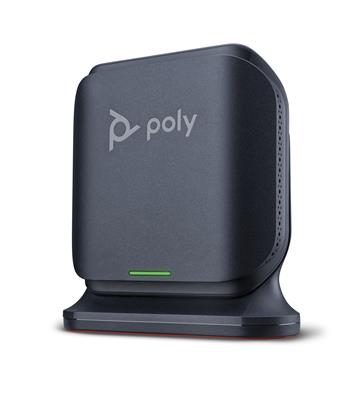
Poly Rove R8 (DECT Repeater)
2200-86840-101
 Call our sales team
Poly Rove R8 — a DECT repeater that extends base station coverage where the signal does not reach. It needs no data socket, a mains one is enough, and it supports encrypted daisy chaining. The power adapter is in the box.
Extends base station coverage
No data socket, a mains one is enough
Encrypted daisy chaining
Up to six per B2, three per B4
Up to 300 m outdoors
Power adapter and stand in the box
Order code | Product | Type | Deployment | Simultaneous calls | Power |
|---|---|---|---|---|---|
8J8W3AA#ABB | Rove B2 | base station | single or dual cell | up to 10, single cell | adapter in the box |
8J8W4AA#ABB | Rove B4 | base station | multicell, up to 254 stations | up to 8 per station, 2,000 per system | PoE, adapter not in the box |
84H79AA#ABB | Rove R8 (this product) | repeater | extends base station coverage | no capacity of its own | adapter in the box |
A repeater serves nothing on its own. It extends the coverage of an existing Rove B2 or B4 base station. Up to six can be attached to a B2 and up to three to a B4, and it is compatible with all Poly Rove products.
Key features
Extends base station coverage without another data socket
Encrypted daisy chaining, that is repeater behind repeater
Up to six units per Rove B2 base station, up to three per a Rove B1 or B4
Range of up to 50 metres indoors, with a repeater up to 300 metres outdoors depending on the environment
Compatible with all Poly Rove products
End-to-end encryption and DECT security certification
Desk or wall mounting, both the stand and the screws are in the box
A 5 V 2 A power adapter is included in the box
Description
It solves coverage, not capacity
A repeater adds no capacity to the system, neither simultaneous calls nor handset registrations. It solves one thing, the places the base station signal does not reach. Typically a distant wing of a building, a basement, a cold store or an outdoor area. If what the customer lacks is call capacity, a repeater will not help, they need a different or an additional base station.
How many repeaters per station
The number depends on the base station. HP quotes up to six repeaters per Rove B2 and up to three per a Rove B1 or B4. Repeaters can be daisy chained, that is placed one behind another, and the link between them is encrypted. Chaining has its price though, each further link adds delay, so use it only where there is no other way.
A mains socket is all it needs
The greatest practical advantage of a repeater is that it needs no data socket. The base station connects to the network, the repeater is simply plugged into the mains and links to the station wirelessly. Where running data cabling would mean building work, that is the difference between a project costing a few thousand and one costing tens of thousands. It mounts on a desk or on a wall, with both the stand and the screws in the box.
Strengths and limits
Strengths
It needs no data socket, a mains one is enough, so no cabling has to be run
The power adapter, the desk stand and the wall screws are all in the box
Encrypted daisy chaining, a repeater can be placed behind another repeater
Compatible with all Poly Rove products
Limits and what to tell the customer
It adds no capacity. A repeater raises neither the number of simultaneous calls nor the number of handsets, it only solves coverage.
Without a base station it is unusable. It has to link to a Rove B2 or B4.
The count is limited by the station, up to six on a B2 but only three on a B4 or B1.
HP's US spec sheet quotes the 1920 to 1930 MHz band, while European base stations work in 1880 to 1900 MHz. Order the #ABB code.
⚑ atlantis note
Design the system top down, from the base station to the handsets
A Rove enquiry usually arrives as a handset count. A usable specification starts elsewhere, with the number of simultaneous calls at peak and the area to be covered. That determines the choice between the B2 and the B4 and the number of R8 repeaters. Only then are the Rove 30 or Rove 40 handsets added. The reverse order ends in a follow-up order and an unhappy customer.
Do not mix goods from different regions
European Rove base stations work in the 1880 to 1900 MHz band, while the US versions of the handsets and the repeater use 1920 to 1930 MHz. The handset auto configures to the band of the base station, but even so order the whole system in European codes with the #ABB suffix and do not top it up with goods from other regions.
A repeater is not a substitute for a second base station
A repeater is often offered as the cheaper answer where another base station is what is actually needed. The difference lies in what the customer is missing. If there is no signal in a remote part of the building, deploy a repeater. If capacity is short because not everyone gets through at peak, a repeater will not help and a station is needed. So ask whether the complaint is "no signal" or "engaged".
Who it suits
Recommended use | a DECT repeater for extending the range of a Poly Rove base station |
|---|---|
Position in the portfolio | wireless DECT phones, the Poly Rove system, infrastructure part |
How it differs from the other products in the range | unlike the base stations it has no call capacity of its own and registers no handsets, it solves coverage alone and needs no data socket |
Suitable
A remote wing of a building, a basement, a warehouse with high racking, an outdoor area or any place without a data socket where running cabling would mean building work.
Verify
Whether what the customer lacks is signal or call capacity. Which base station is deployed and how many repeaters already hang off it. Where the mains socket is at the target location. Whether chaining will be needed and how many links.
Consider another product
Another Rove B4 base station if what is short is call capacity rather than signal. A Rove B2 station where the system is only being started and nothing is deployed yet.
The "Verify" and "Consider another product" cards come from the experience of the atlantis team.
What the repeater serves
Base station
Rove B2 or B4
The repeater links wirelessly to a base station and extends its range. Up to six units per B2 station and up to three per a B1 or B4.
up to 6× on B2
up to 3× on B4
Daisy chaining
Repeater behind repeater
Repeaters can be placed one behind another and the link between them is encrypted. Each further link adds delay though, so use it only where there is no other way.
chaining
encrypted
Power and mounting
A mains socket
A 5 V 2 A adapter is in the box and no data socket is needed. It mounts on a desk using the stand or on a wall, with the screws in the box.
no data socket
desk or wall
Platform for this order code: DECT, a Poly Rove repeater, compatible with all Rove products. Handset and SIP registration are handled by the base station, not by the repeater.
Connectivity, network and security
Wireless technology | DECT; HP's US spec sheet quotes the 1920 to 1930 MHz band, while the European B2 and B4 base stations work in 1880 to 1900 MHz |
|---|---|
Deployment | extends base station coverage, repeaters can be daisy chained |
Range | up to 50 m indoors, with a repeater up to 300 m outdoors depending on the environment |
Network port | the repeater does not need one, it links to the base station wirelessly |
Power | external universal 5 V 2 A adapter, in the box |
Security | end-to-end encryption, encrypted chaining, DECT security certified |
Units per station | up to six on a Rove B2, up to three on a Rove B1 or B4 |
Operating temperature | −10 to 55 °C |
Coverage, mounting and power
Simultaneous calls | the repeater has no capacity of its own, it relays the capacity of the base station |
|---|---|
Units per base station | up to six on a Rove B2, up to three on a Rove B1 or B4 |
Handset registration | the repeater registers no handsets, registration is held by the base station |
Daisy chaining | supported, the link between repeaters is encrypted |
Coverage | range of up to 50 m indoors, with a repeater up to 300 m outdoors depending on the environment |
Mounting | on a desk using the stand or on a wall, both the stand and the screws being in the box |
Power | 5 V 2 A adapter, in the box |
Weight | 166 g |
Operating temperature | −10 to 55 °C |
In the box
In the box
Rove R8 repeater
Power adapter
Desk stand and wall mount screws
Quick start guide and safety information sheet
Not included
Base station, Rove B2 code 8J8W3AA#ABB or Rove B4 code 8J8W4AA#ABB
Handsets, Rove 30 code 84H76AA#ABB or Rove 40 code 84H77AA#ABB
Network cable, the repeater does not need one
Any PBX licence or service
Poly+ Partner service programme
Order with it
Poly Rove 40 handset with Bluetooth84H77AA#ABB
A rugged IP65 handset with Bluetooth 4.2 for a wireless headset. Battery, cradle and adapter are all in the box.
Poly Rove 30 handset84H76AA#ABB
The same durability and endurance as the Rove 40, without Bluetooth. A headset connects via the 3.5 mm jack.
Poly Rove B2 base station8J8W3AA#ABB
The core of a system for one or two cells. Up to six repeaters per station.
Li-ion battery for Rove 30 and 4085W99AA
A second battery to swap in multishift operation.
Poly Rove power adapter85W97AA#ABB
A universal adapter for the Rove 30, 40, B2, B4 and R8. A spare for the repeater, which has an adapter in the box.
Poly+ Partnerby model and term
Extended support with expedited replacement, ordered together with the device.
Variants and products in the range
Range | Type | What characterises it | Intended for |
|---|---|---|---|
Poly Rove ◂ this product | DECT system | a base station, repeaters and rugged IP65 handsets | moving around a building, warehouse, production |
Poly Edge E | IP desk phone | eight models from 2 to 14 keys, classic key based operation | ordinary and demanding office positions |
Poly CCX | IP desk phone with touch | Android 12, touch display, Open SIP and Microsoft Teams versions | positions with touch operation |
Poly Trio 8300 | conference phone | SIP, Wi-Fi, Bluetooth, 3.7 m pickup | medium meeting room |
Poly Trio C60 | conference phone | SIP, Wi-Fi, Bluetooth, DECT, Teams version | larger meeting room |
What to verify before ordering and deploying
Signal or capacity: a repeater solves coverage alone, it will not raise call capacity
Which base station is deployed: a B2 takes up to six repeaters, a B1 or B4 only three
How many repeaters already hang off the station: the limit counts per station, not per system
A mains socket at the target location: no data socket is needed, a mains one is
Chaining: supported and encrypted, but each further link adds delay
Order code: the European #ABB, do not mix goods from other regions
The atlantis team helps with every point. From the coverage design and the choice of base station through connecting to the PBX to handset registration and user training.
Management and services
System management: configuration, handset registration and service profile assignment are done on the base station, not on the handset
Poly+ Partner: local support from an experienced certified team in Czech, by phone, chat, web and video call, priority device replacement where the manufacturer ships the replacement the next business day and covers the shipping, all under the terms of the programme and for its entire validity, so the care can continue after the warranty ends
atlantis deployment: coverage design, the choice of base station and the number of repeaters, connection to a PBX or cloud service, handset registration and user training
Warranty
Standard one-year HP Poly limited warranty. Extended support with expedited replacement is provided by the Poly+ Partner programme.
FAQ
Will a repeater raise the number of simultaneous calls?
No. A repeater solves coverage alone, that is the places the base station signal does not reach. It raises neither call capacity nor the number of registered handsets, both of which are set by the base station. If the customer cannot get through at peak, a different or an additional station is needed, not a repeater.
How many repeaters can be attached to one station?
Up to six Rove R8 repeaters on a Rove B2 station and up to three on a Rove B1 or B4. The limit counts per base station, not per system, so in a multicell B4 system the totals add up with the number of stations.
Does a repeater need a data socket?
No. The repeater links to the base station wirelessly and a mains socket is all it needs. A 5 V 2 A power adapter is in the box. That is the main reason coverage of remote places is solved with a repeater rather than another base station.
Can the repeater be wall mounted?
Yes. The box holds both a desk stand and wall mount screws. We recommend confirming the placement by measurement rather than estimating it from the floor plan.
Can repeaters be placed one behind another?
Yes, encrypted daisy chaining is supported. Each further link in the chain adds delay though, so use it only where direct coverage from the base station is not possible.
Which DECT band does the repeater work in?
HP's US spec sheet quotes the 1920 to 1930 MHz band for the repeater. The European Rove B2 and B4 base stations work in 1880 to 1900 MHz. Order the whole system in European codes with the #ABB suffix.
- Manufacturer
- Poly HP
- Weight
- 0.19 kg
No attachments available.
Not sure what to choose?
We're happy to help you choose!
Every business day from 8:00 to 17:00